Have you noticed?Today's internet seems to give people only two identities: consumer or creator.But maybe all you want is a cozy little garden of your own.
Jant is the Tumblr-style blog made for exactly this, built on
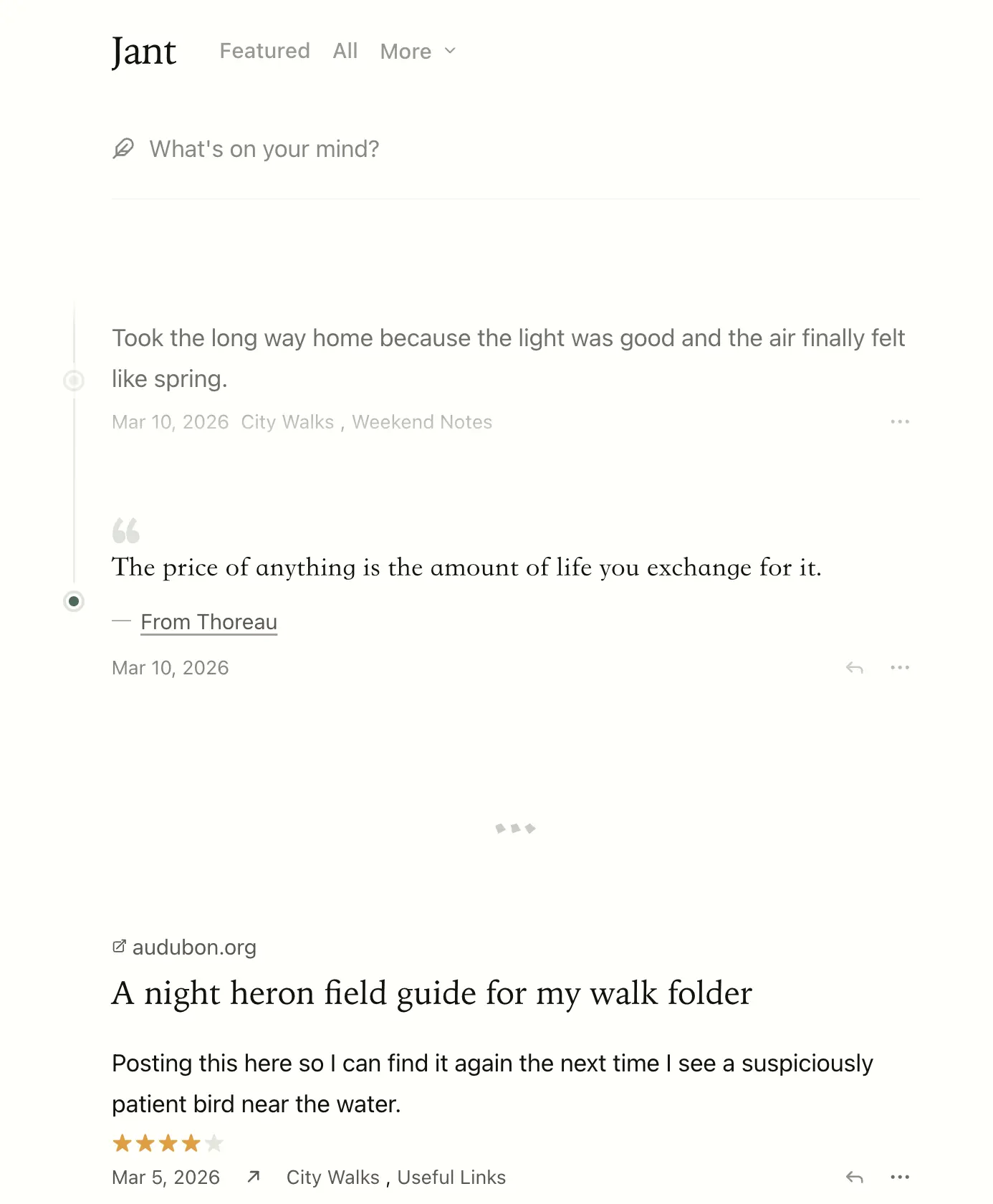
Learned a new word, "enshittification": as an online service grows its user base, it chases margins and lets the service slowly turn to shit.
David Perell: "Make no mistake. For the conscious news consumer, there has never been a better time to be alive. The Internet is filled with high-quality information, so savvy information consumers have access to more high-quality knowledge than at any point in human history"
Basically, when you get to my age, you'll really measure your success in life by how many of the people you want to have love you actually do love you.
Jant is an open-source, Tumblr-style blog that sits between a traditional blog and social media. I've used both for a long time, and neither fully satisfies me. The main problem with a traditional blog is that publishing is a heavy lift: writing usually means coming up with a title and finishing a full article, so many blogs are rarely updated. Social media makes posting easy, but every post is pushed to all your followers and becomes traffic and data for the platform.
Jant sets out to solve the problem in between: posting with as little friction as on social media, while the content stays ours, the way it does on a traditional blog.
Here's how:
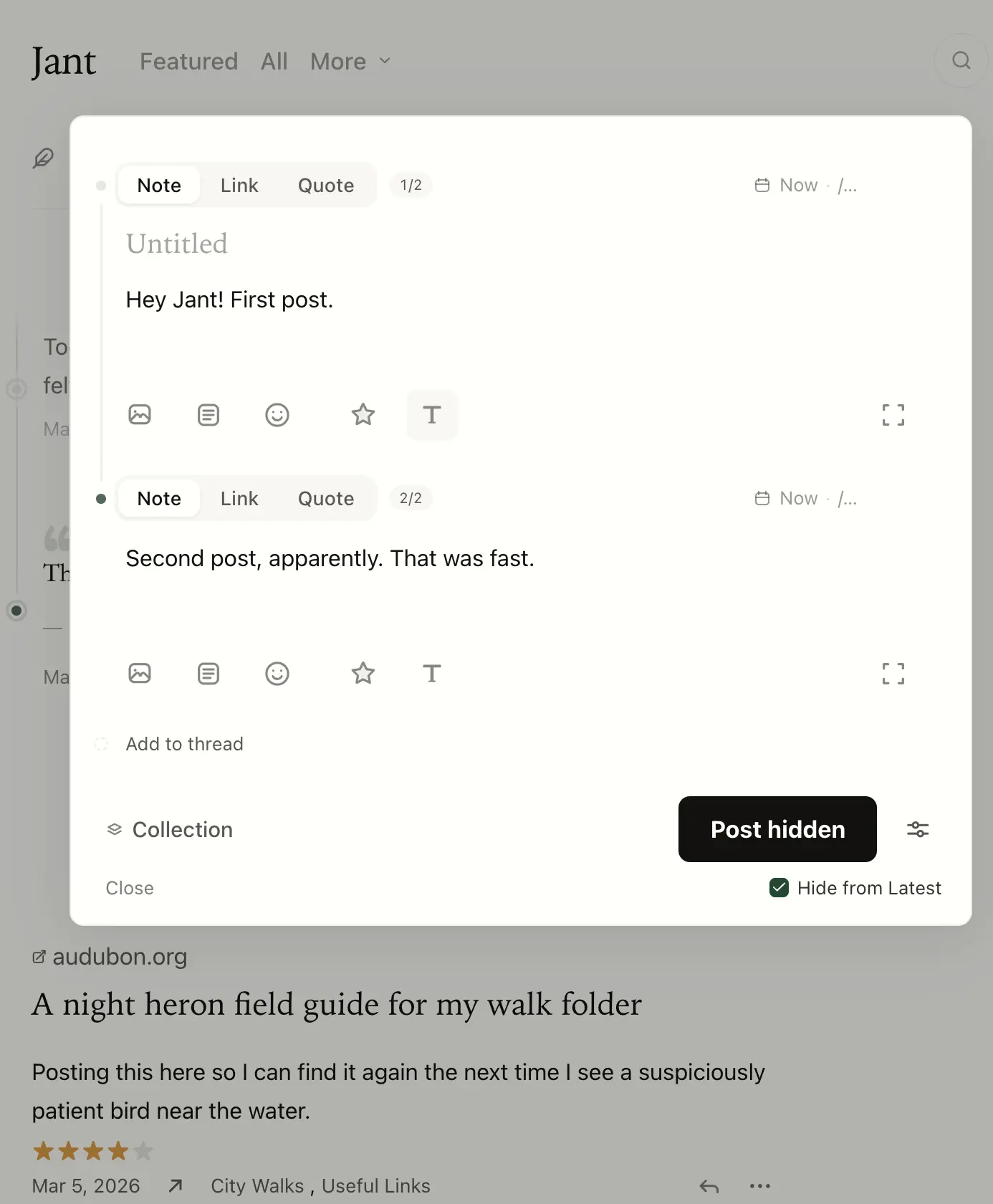
Blog the way you post an update. Posts come in three formats: Note, Link, and Quote. The Link and Quote formats are for sharing links and excerpts. A Note's title is optional, and a Thread strings several posts together. That way, posts of every form and length become a natural part of the blog.
Publishing isn't broadcasting. On traditional blogs and social media, publishing means pushing to every subscriber. The thought of interrupting that many people often makes us hesitate to post, so a lot of things worth keeping never get posted (think about whether the same is true of what we post on social media). So in Jant, by default only posts marked Featured go into the RSS feed. When you post, you can also keep it off the home page. The post stays public and still appears in the archive and in its Collections.
No followers, likes, or algorithmic recommendations. The name Jant comes from the Nordic Jantelagen (the Law of Jante), roughly "don't show off, don't compare." In Scandinavia the word leans negative, but what I like is its other side: not comparing, not intruding.
Our content stays ours. A whole Jant blog can sync automatically to a GitHub repository, with each post as a Markdown file. The repository itself is a complete Hugo static site. Jant is open source too, and can be deployed to Cloudflare or your own server.
Features
Three formats, plus attachments and ratings
These are the three basic formats Jant distilled for personal blogs. With attachments and ratings, an author can grow a rich digital garden of their own.
NoteLinkQuoteMediaRating
Low-pressure public writing
Only Featured posts are pushed to RSS subscribers. Any post can also be hidden from Latest.
Hosted Jant is run and maintained by Jant, with automatic upgrades, HTTPS certificates, and custom domains built in. Ideal for users who don't want to manage servers.
Is Jant open-source software? Are there any feature differences between hosted and self-hosted?
Yes. The full source is on GitHub. Hosted and self-hosted run the same code — there are no "hosted-only" features.
Why is hosted priced at $10.46 / year?
It's what Cloudflare charges to register and renew a .com. Sits just above free, just formal enough — low enough not to add friction at the start, but not so trivial that you don't take it seriously.
Can I try it first? What if it isn't for me?
Within 14 days of your first payment, you get a full refund, no questions asked, and you can do it yourself from the Billing page. You can also try the demo first, no sign-up needed.
Who should choose self-hosted Jant, and who should use the official hosted service?
Not built-in. May come later. For now, use code injection to embed giscus, Disqus, or another third-party system.
Why the name Jant?
The name comes from Jantelagen — a concept from a 1933 Nordic satirical novel, often summarized as "don't show off, don't compare." In Scandinavia the term carries a critical edge, often invoked as shorthand for a collective culture that suppresses individuality. Happiness researchers tend to read it the other way around: a quiet agreement not to compete or intrude on each other is part of what makes Nordic societies feel calm, and one of the reasons people there report being so content.
Today's social networks push in exactly the opposite direction:
One pressure comes from watching others — constant performance and comparison, which feeds anxiety.
The other comes from being watched — every post is force-pushed to all your followers, until the weight of it kills the urge to say anything at all.
Most blog systems inherited the same logic, treating "published" and "broadcast" as a single decision — you post something, and it lands in your RSS feed, your subscribers' readers, and your homepage timeline at the same moment. Jant separates publishing from broadcasting: each post chooses its distribution — hidden from Latest, shown on Latest, or marked Featured to enter /feed and push to RSS.